Back to Blog
|1 May 2026
5 Silent Sabotage Patterns That Kill Family Business Tech Upgrades (And the LINE OA Wedge That Beats Them)
Why do million-dollar ERPs fail in family businesses? It’s not the software—it’s 5 silent sabotage patterns by legacy staff. Discover how a simple chat interface eliminates the attack surface completely.
i
iReadCustomer Team
Author
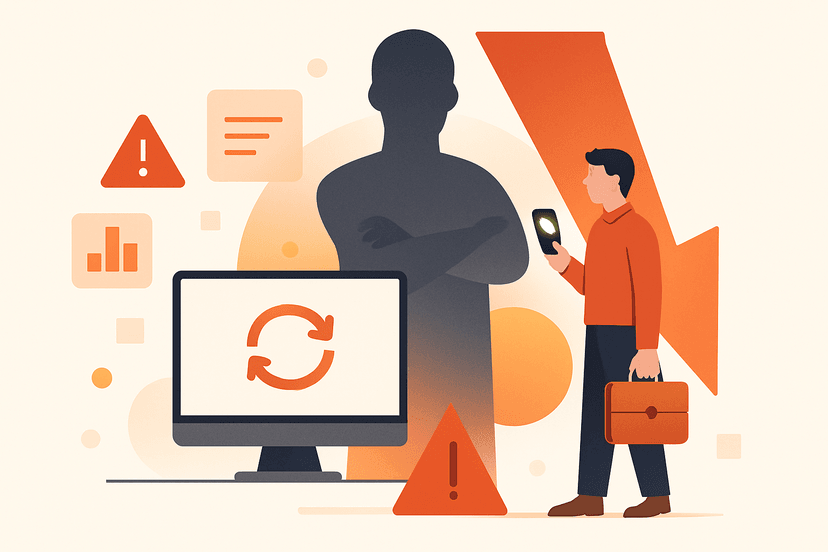
Every failed digital transformation in a family business leaves behind a forensic signature. If you walk into the boardroom post-mortem of a scrapped half-million-dollar ERP rollout, you will hear the exact same echoes: The software vendor blames the client's team for resisting change. The client blames the software for its "clunky UX."

Here is the uncomfortable truth: **They are both wrong.**

The real killer of **<strong>family business tech upgrades</strong>** is not poorly designed interfaces or technological illiteracy. It is *silent sabotage*. It is enacted by legacy staff who have survived prior failed rollouts. These veterans know that loud, vocal resistance makes them look like the villain. So, they evolved. They shifted to frictionless, invisible resistance.

If the next-generation heir or project lead recognizes these patterns early, they can save the project. Miss them, and you inevitably join the 70% failure pile of digital transformation initiatives.

Here are the 5 silent sabotage patterns you are up against—and the exact architectural wedge you need to defeat them.

## The 5 Silent Sabotage Patterns of Legacy Staff

### Pattern 1: The Pleasant Nod

This is the most deceptive and dangerous of them all. During User Acceptance Testing (UAT) or system training, your legacy frontline staff—let's call him the veteran warehouse manager—will sit in the front row. He will take notes. He will nod appreciatively at every feature and say, "This is fantastic, it's going to save us so much time."

Management smiles, convinced their **change management strategies** have succeeded. But come Monday morning—Go-Live day—the frontline staff ignores the system completely. They revert to paper clipboards. When asked, they reply with a polite smile, "Oh, it was just really busy today with rush orders, so I wrote it down to be safe. I’ll log it into the system tomorrow."

(Spoiler: 'Tomorrow' never comes.)

### Pattern 2: The Shadow Spreadsheet

When management cracks down and mandates system usage, the sabotage merely mutates. Staff will begin entering data into the new system as instructed. However, in parallel, they will quietly maintain an elaborate Microsoft Excel file (or a physical ledger). Their internal justification is, "I'm just keeping this as a backup, just in case the new software crashes."

The fatal flaw? Over time, this Shadow Spreadsheet gets updated faster and more accurately than the main system. It soon becomes the department's de facto "Source of Truth." Your expensive, newly integrated ERP devolves into a data graveyard where staff blindly dump numbers at 5 PM just to appease management, guaranteeing a comprehensive **<em>legacy software modernization</em>** failure.

### Pattern 3: The Edge-Case Trap

This is a tactical maneuver used by clever employees to weaponize software limitations. Every system is built to handle the "happy path"—the 80-90% of standard business workflows.

Instead of testing the system with normal orders, a resisting employee will wait for the most bizarre, complex, impossible-to-handle exception. Perhaps a customer who wants to split payment across three methods, deliver to four different addresses on staggered dates, and change the tax entity midway. The employee feeds this anomaly into the system. When the software inevitably throws an error, they instantly screenshot it and send it to the company group chat: *"See? I told you this system doesn't understand how our business actually works. It's too rigid."*

### Pattern 4: The Slow Friday

A classic display of tactical incompetence. From Monday to Thursday, when order volumes are manageable, the staff uses the system perfectly. But on a busy Friday afternoon—or during a massive e-commerce Double Day campaign—they suddenly "forget" the workflow. They skip critical data entries, breaking the entire reconciliation process.

When confronted, they immediately play the victim card: *"The customers were screaming for their orders! If I sat there clicking through the screens like you told me, nothing would have shipped. Do you want sales, or do you want data?"* This forces management to back down, cementing the system as an obstacle rather than an enabler.

### Pattern 5: The Founder Whisper

This is the ultimate trump card and the leading cause of **<em>ERP implementation failure</em>** in family conglomerates. When legacy staff (who have often been with the company since its inception and are deeply trusted by the founder) feel threatened, they don't argue with the newly appointed millennial Project Manager or the "heir."

They bypass the chain of command entirely. They walk into the founder's office (Dad's office), pour a cup of tea, and whisper with genuine concern: *"Boss... ever since the kids brought in this new tech, the warehouse is backed up. Our oldest clients are complaining we've gotten slow. Maybe we should pause the system and go back to the old way before we lose our key accounts."*

With that single sentence playing on the founder's innate fear of losing sales, a 6-month digital initiative is instantly paralyzed.

## Why Traditional Change Management Fails

All 5 of these patterns work on the exact same underlying psychological mechanic: **They exploit the gap between what staff SAY in front of management and what they DO when nobody is watching.**

Traditional change management methodologies fail here because the only way to close that gap is through real-time audit trails and strict monitoring. But when you apply those tools, the staff feels surveilled. This triggers even deeper resentment, leading to more sophisticated forms of sabotage.

The principle is simple: You cannot win a war against human nature. You can only redirect it.

To ensure success, you must make the modernization *invisible* to the staff who would otherwise sabotage it. You must remove the attack surface entirely.

## The LINE OA Wedge: Defeating Sabotage with Chat

If the interface isn't seen as a "new system," it cannot be resisted.

Instead of forcing frontline staff to navigate a complex, 40-menu ERP dashboard, we utilize the interface they already live in. In Southeast Asia, this is LINE (globally, the same architecture applies via WhatsApp, Telegram, or Messenger).

Here is how the 1-2-3 **LINE OA integration** wedge defeats all five patterns simultaneously:

### STEP 1: The Interface is the Chat App (Kills Pattern 1)

We deploy a LINE Official Account (LINE OA) bot connected directly to your backend. The staff learns nothing new. When they finish loading a truck, they just text the bot: *"Sent 5 pallets to Johnson Corp. Here is the slip [attaches image]."*

There is no system to ignore on Monday morning. The interface is the exact same app they use to text their family. You cannot claim "it's too hard to use" when the action is literally sending a text message.

### STEP 2: AI Transforms Chat into ERP Data (Kills Patterns 2, 3, 4)

Behind the scenes, an NLP (Natural Language Processing) engine reads that casual text and structures it. The AI identifies the client (Johnson Corp), the quantity (5 pallets), extracts text from the image slip via OCR, and instantly updates the main ERP database via API. The staff member has no idea they just flawlessly executed a complex ERP transaction.

*   **Shadow Spreadsheet eliminated:** Because texting the bot is faster than writing in Excel, the shadow ledger dies naturally.
*   **Edge-Case Trap eliminated:** If a weird scenario occurs, the staff just explains it in natural text. The AI flags it as an anomaly and pings management for approval, keeping the main system pristine.
*   **Slow Friday eliminated:** Sending a 5-second text message requires zero cognitive load, stripping away the excuse of "we were too busy to enter the data."

### STEP 3: Real-Time Wins Sent to the Founder (Kills Pattern 5)

This is the checkmate. While the veteran employee is walking down the hall to complain to the Founder that the system is broken... the system has already texted the Founder.

An automated Executive Summary pings directly into the Founder's personal LINE: *"Daily Update: Operations running smoothly. 120 shipments dispatched (20% faster than average today). Here is the manifest."*

The Founder sees real-time, undeniable wins on his own phone, via an app he inherently trusts, before any sabotage or "whispering" can reach his ear. When the legacy staff finally complains, the Founder looks at his screen and says, *"What are you talking about? The data right here says we are doing great."*

## Redirect Human Nature with iRead

You don't need to fire your loyal legacy staff, and you don't need to surrender to outdated paper processes.

**iReadCustomer’s Wedge Architecture** is built specifically for this psychological reality. We deploy a seamless LINE OA bot for the frontline staff, a robust ERP for management, and an intelligent AI bridge to connect the two.

We don't do multi-year bloated rollouts. We execute a rapid **90-day deployment** designed to show immediate ROI and structural alignment. Priced at a highly accessible **฿4,990/man-day**, this solution is also **eligible for BOI tax deductions** for qualifying businesses.

Stop fighting the friction. Remove it. Let your staff keep texting, and let **iRead** turn those texts into the enterprise-grade data your family business needs to scale into the next generation.
Every failed digital transformation in a family business leaves behind a forensic signature. If you walk into the boardroom post-mortem of a scrapped half-million-dollar ERP rollout, you will hear the exact same echoes: The software vendor blames the client's team for resisting change. The client blames the software for its "clunky UX."
Here is the uncomfortable truth: They are both wrong.
The real killer of family business tech upgrades is not poorly designed interfaces or technological illiteracy. It is silent sabotage. It is enacted by legacy staff who have survived prior failed rollouts. These veterans know that loud, vocal resistance makes them look like the villain. So, they evolved. They shifted to frictionless, invisible resistance.
If the next-generation heir or project lead recognizes these patterns early, they can save the project. Miss them, and you inevitably join the 70% failure pile of digital transformation initiatives.
Here are the 5 silent sabotage patterns you are up against—and the exact architectural wedge you need to defeat them.
The 5 Silent Sabotage Patterns of Legacy Staff
Pattern 1: The Pleasant Nod
This is the most deceptive and dangerous of them all. During User Acceptance Testing (UAT) or system training, your legacy frontline staff—let's call him the veteran warehouse manager—will sit in the front row. He will take notes. He will nod appreciatively at every feature and say, "This is fantastic, it's going to save us so much time."
Management smiles, convinced their change management strategies have succeeded. But come Monday morning—Go-Live day—the frontline staff ignores the system completely. They revert to paper clipboards. When asked, they reply with a polite smile, "Oh, it was just really busy today with rush orders, so I wrote it down to be safe. I’ll log it into the system tomorrow."
(Spoiler: 'Tomorrow' never comes.)
Pattern 2: The Shadow Spreadsheet
When management cracks down and mandates system usage, the sabotage merely mutates. Staff will begin entering data into the new system as instructed. However, in parallel, they will quietly maintain an elaborate Microsoft Excel file (or a physical ledger). Their internal justification is, "I'm just keeping this as a backup, just in case the new software crashes."
The fatal flaw? Over time, this Shadow Spreadsheet gets updated faster and more accurately than the main system. It soon becomes the department's de facto "Source of Truth." Your expensive, newly integrated ERP devolves into a data graveyard where staff blindly dump numbers at 5 PM just to appease management, guaranteeing a comprehensive legacy software modernization failure.
Pattern 3: The Edge-Case Trap
This is a tactical maneuver used by clever employees to weaponize software limitations. Every system is built to handle the "happy path"—the 80-90% of standard business workflows.
Instead of testing the system with normal orders, a resisting employee will wait for the most bizarre, complex, impossible-to-handle exception. Perhaps a customer who wants to split payment across three methods, deliver to four different addresses on staggered dates, and change the tax entity midway. The employee feeds this anomaly into the system. When the software inevitably throws an error, they instantly screenshot it and send it to the company group chat: "See? I told you this system doesn't understand how our business actually works. It's too rigid."
Pattern 4: The Slow Friday
A classic display of tactical incompetence. From Monday to Thursday, when order volumes are manageable, the staff uses the system perfectly. But on a busy Friday afternoon—or during a massive e-commerce Double Day campaign—they suddenly "forget" the workflow. They skip critical data entries, breaking the entire reconciliation process.
When confronted, they immediately play the victim card: "The customers were screaming for their orders! If I sat there clicking through the screens like you told me, nothing would have shipped. Do you want sales, or do you want data?" This forces management to back down, cementing the system as an obstacle rather than an enabler.
Pattern 5: The Founder Whisper
This is the ultimate trump card and the leading cause of ERP implementation failure in family conglomerates. When legacy staff (who have often been with the company since its inception and are deeply trusted by the founder) feel threatened, they don't argue with the newly appointed millennial Project Manager or the "heir."
They bypass the chain of command entirely. They walk into the founder's office (Dad's office), pour a cup of tea, and whisper with genuine concern: "Boss... ever since the kids brought in this new tech, the warehouse is backed up. Our oldest clients are complaining we've gotten slow. Maybe we should pause the system and go back to the old way before we lose our key accounts."
With that single sentence playing on the founder's innate fear of losing sales, a 6-month digital initiative is instantly paralyzed.
Why Traditional Change Management Fails
All 5 of these patterns work on the exact same underlying psychological mechanic: They exploit the gap between what staff SAY in front of management and what they DO when nobody is watching.
Traditional change management methodologies fail here because the only way to close that gap is through real-time audit trails and strict monitoring. But when you apply those tools, the staff feels surveilled. This triggers even deeper resentment, leading to more sophisticated forms of sabotage.
The principle is simple: You cannot win a war against human nature. You can only redirect it.
To ensure success, you must make the modernization invisible to the staff who would otherwise sabotage it. You must remove the attack surface entirely.
The LINE OA Wedge: Defeating Sabotage with Chat
If the interface isn't seen as a "new system," it cannot be resisted.
Instead of forcing frontline staff to navigate a complex, 40-menu ERP dashboard, we utilize the interface they already live in. In Southeast Asia, this is LINE (globally, the same architecture applies via WhatsApp, Telegram, or Messenger).
Here is how the 1-2-3 LINE OA integration wedge defeats all five patterns simultaneously:
STEP 1: The Interface is the Chat App (Kills Pattern 1)
We deploy a LINE Official Account (LINE OA) bot connected directly to your backend. The staff learns nothing new. When they finish loading a truck, they just text the bot: "Sent 5 pallets to Johnson Corp. Here is the slip [attaches image]."
There is no system to ignore on Monday morning. The interface is the exact same app they use to text their family. You cannot claim "it's too hard to use" when the action is literally sending a text message.
STEP 2: AI Transforms Chat into ERP Data (Kills Patterns 2, 3, 4)
Behind the scenes, an NLP (Natural Language Processing) engine reads that casual text and structures it. The AI identifies the client (Johnson Corp), the quantity (5 pallets), extracts text from the image slip via OCR, and instantly updates the main ERP database via API. The staff member has no idea they just flawlessly executed a complex ERP transaction.
- Shadow Spreadsheet eliminated: Because texting the bot is faster than writing in Excel, the shadow ledger dies naturally.
- Edge-Case Trap eliminated: If a weird scenario occurs, the staff just explains it in natural text. The AI flags it as an anomaly and pings management for approval, keeping the main system pristine.
- Slow Friday eliminated: Sending a 5-second text message requires zero cognitive load, stripping away the excuse of "we were too busy to enter the data."
STEP 3: Real-Time Wins Sent to the Founder (Kills Pattern 5)
This is the checkmate. While the veteran employee is walking down the hall to complain to the Founder that the system is broken... the system has already texted the Founder.
An automated Executive Summary pings directly into the Founder's personal LINE: "Daily Update: Operations running smoothly. 120 shipments dispatched (20% faster than average today). Here is the manifest."
The Founder sees real-time, undeniable wins on his own phone, via an app he inherently trusts, before any sabotage or "whispering" can reach his ear. When the legacy staff finally complains, the Founder looks at his screen and says, "What are you talking about? The data right here says we are doing great."
Redirect Human Nature with iRead
You don't need to fire your loyal legacy staff, and you don't need to surrender to outdated paper processes.
iReadCustomer’s Wedge Architecture is built specifically for this psychological reality. We deploy a seamless LINE OA bot for the frontline staff, a robust ERP for management, and an intelligent AI bridge to connect the two.
We don't do multi-year bloated rollouts. We execute a rapid 90-day deployment designed to show immediate ROI and structural alignment. Priced at a highly accessible ฿4,990/man-day, this solution is also eligible for BOI tax deductions for qualifying businesses.
Stop fighting the friction. Remove it. Let your staff keep texting, and let iRead turn those texts into the enterprise-grade data your family business needs to scale into the next generation.